Custom-fabricated gutter systems engineered for Middle Tennessee's 52 inches of annual rainfall, Dixie Alley severe storms, and year-round tree debris from Eastern Red Cedar, oak, and sugar maple forests.
Murfreesboro sits at the intersection of rapid growth and demanding weather. With more than 148 active new home communities pushing the city's population past 175,000, the demand for properly engineered gutter systems has never been higher. Yet the challenge extends beyond new construction: homes built during the 2000-to-2010 building boom are now approaching their first gutter replacement cycle, and the lightweight builder-grade gutters installed during that era are showing the strain of two decades under Middle Tennessee's punishing conditions.
The region's humid subtropical climate delivers 52 inches of rainfall annually — 37 percent above the national average — with the heaviest months stretching from May through July and again in December. Dixie Alley severe weather adds another dimension. Middle Tennessee averages roughly 16 tornadoes per year, and the straight-line winds, hail, and debris from these storm systems can destroy poorly installed gutter systems in a single event. A gutter installation designed for this environment must account for all of it: heavy water volume, wind loads, persistent tree debris, and the freeze-thaw cycles that accompany ice storms every five years or so.
Material selection is the foundation of a gutter installation that performs in Murfreesboro's climate. The humid subtropical conditions, combined with acidic runoff from Eastern Red Cedar and oak-hickory canopies, create an environment where cheaper materials fail faster than in drier regions.
Free estimates for all Murfreesboro and Rutherford County properties.
Sectional gutters are assembled from pre-cut lengths joined by connectors and sealed at each joint. In a climate that delivers 52 inches of rain annually and subjects gutters to the thermal cycling of Middle Tennessee's summers and winters, those joints are the weakest link. Sealant degrades, connectors shift, and every seam becomes a potential leak point within 5 to 10 years.
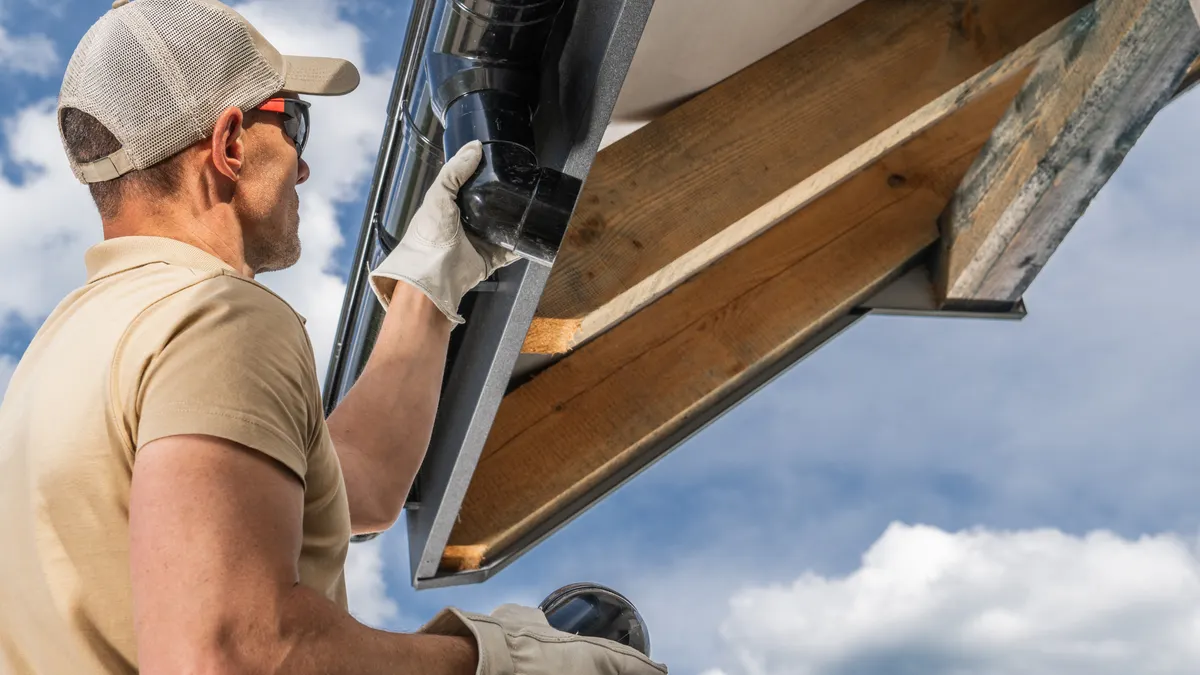
Seamless gutters are fabricated on-site from a portable roll-forming machine that shapes continuous aluminum coil to the exact length of each roof run. The only joints occur at corners and downspout outlets, reducing potential leak points by 80 to 90 percent compared to sectional systems. For Murfreesboro homes surrounded by Eastern Red Cedar and oak-hickory forests, seamless channels also resist debris accumulation better — there are no ridges or seam bumps where leaves and needles can catch and dam water flow.
On-site fabrication also means precise fitting. Each run is measured and formed to the exact dimension of the fascia, with hidden hangers installed at intervals appropriate for the expected load. For standard residential applications, 24-inch hanger spacing is the recommendation — tighter than the 36-inch spacing common in builder-grade installations but necessary for gutters that must hold standing water and debris during heavy storm events.
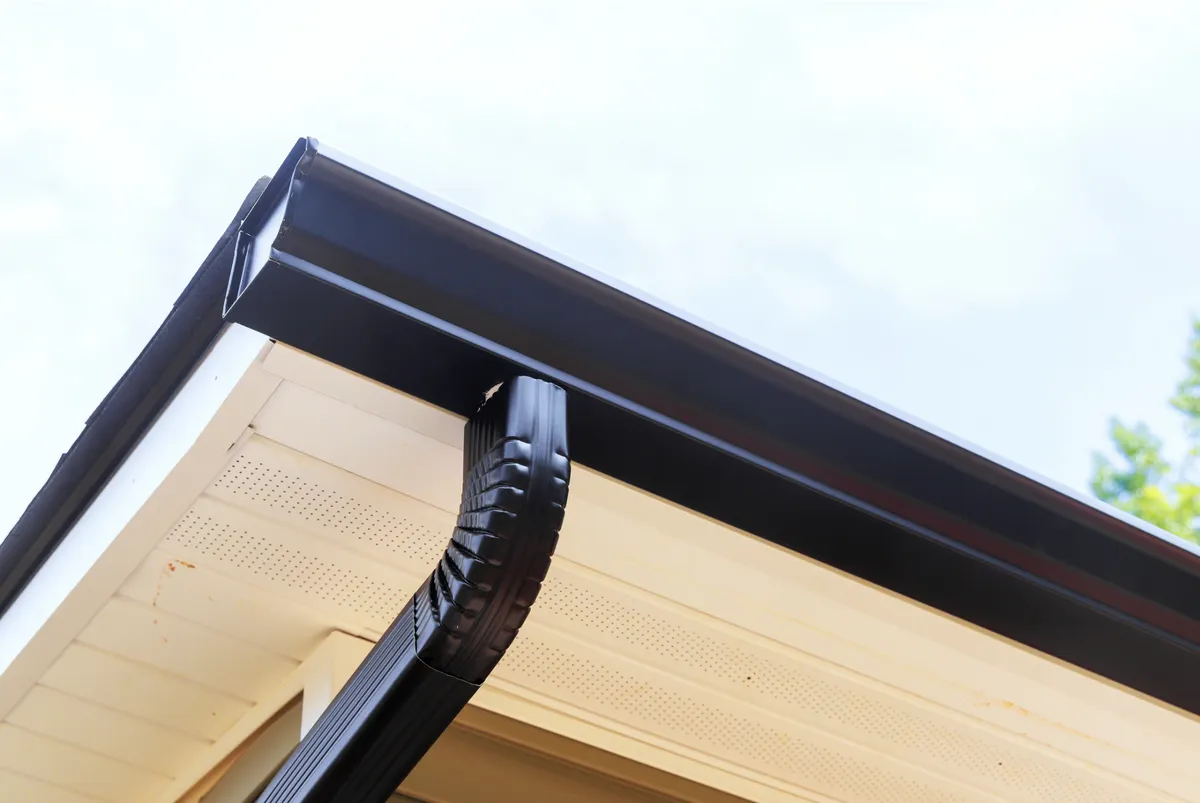
K-style gutters dominate the Murfreesboro residential market for good reason. The flat back mounts flush against the fascia board, the decorative front profile complements most architectural styles built since the 1990s, and the shape carries more water per inch of width than a comparable half-round gutter. For a region that receives 52 inches of rainfall, that additional capacity is not a luxury — it is a functional requirement.
The standard 5-inch K-style channel handles most single-story roofs with moderate pitch. However, for homes with steep pitches, large roof surfaces, or heavy tree cover that introduces debris weight into the channel, upgrading to a 6-inch K-style profile is the recommended approach. The 6-inch channel increases water-carrying capacity by approximately 40 percent over the 5-inch, providing a meaningful safety margin during the intense downpours that accompany summer thunderstorms and Dixie Alley severe weather.
Half-round gutters serve a more specialized role. Their semicircular profile sheds debris more easily than K-style, reducing maintenance needs on heavily wooded lots. They are also the historically accurate choice for older homes in Murfreesboro's established neighborhoods. The trade-off is reduced capacity: a 6-inch half-round carries roughly the same volume as a 5-inch K-style, making proper sizing essential.
Murfreesboro's population has grown 14 percent since 2020, making it one of the fastest-expanding cities in Tennessee. That growth has fueled a construction boom that has produced 148 or more active new home communities, from starter neighborhoods in the $300,000 range to premium developments in Nolensville where homes list above $777,000.
New construction presents both an opportunity and a caution for homeowners. Many production builders install the minimum viable gutter system to control construction costs — typically thin-gauge aluminum with wide hanger spacing and sectional connections. These systems meet code but are not optimized for Middle Tennessee's conditions. After 10 to 15 years of 52-inch annual rainfall, tornado-season storms, and constant cedar needle accumulation, builder-grade gutters frequently show sagging, overflowing joints, and hangers pulling free from fascia boards.
Specifying upgraded gutters during construction — or replacing builder-grade systems within the first few years — is a cost-effective approach. The incremental investment in heavier-gauge aluminum, seamless fabrication, and 24-inch hanger spacing typically adds only $500 to $1,000 to a whole-home installation but can extend system life from 15 years to 25 or more.
Current pricing ranges based on Rutherford County market data. All estimates are free with no obligation.
| Material / System | Price Per Linear Foot | Notes |
|---|---|---|
| Vinyl Gutters | $3.70 – $6.50/LF | Budget option; shorter lifespan in humid climates |
| Seamless Aluminum (5") | $5 – $8/LF | Most popular choice for Murfreesboro homes |
| Seamless Aluminum (6") | $6 – $9/LF | Recommended for steep-pitch or high-debris properties |
| Galvanized Steel | $8 – $10/LF | Superior storm resistance; requires coating for humidity |
| Copper | $15 – $25+/LF | Premium durability; 50+ year lifespan |
| Whole-Home Project (150–200 LF) | $1,000 – $2,500 | Standard aluminum system, complete installation |
Pricing varies by project scope, building height, material selection, and roof complexity. Nashville metro labor costs are competitive. Contact Murfreesboro Gutter Pros for a free, detailed estimate.
Expert guidance on materials, profiles, and sizing for every Rutherford County property.
Gutter installation in Murfreesboro ranges from $3.70 to $6.50 per linear foot for vinyl, $5 to $8 per linear foot for seamless aluminum, $8 to $10 per linear foot for steel, and $15 to $25 or more per linear foot for copper. A whole-home aluminum installation for a typical Murfreesboro home runs $1,000 to $2,500 depending on square footage and roof complexity.
Seamless aluminum is the most popular and recommended gutter material for Middle Tennessee's humid subtropical climate. It resists corrosion from the region's high humidity, handles thermal expansion well through hot summers and occasional ice storms, and offers strong performance at $5 to $8 per linear foot. Steel gutters at $8 to $10 per linear foot provide additional strength for storm-prone properties in the Dixie Alley corridor.
Many new construction homes in Murfreesboro's 148-plus active communities come with lightweight builder-grade gutters designed to minimize construction costs. These systems often use thinner-gauge aluminum and wider hanger spacing that may not withstand Middle Tennessee's 52 inches of annual rainfall and severe storm loads long-term. Upgrading to heavier-gauge seamless aluminum with hidden hangers spaced at 24 inches or less during or shortly after construction can prevent premature failure.
K-style gutters feature a flat back and a decorative front profile that resembles crown molding. They carry more water than half-round gutters of the same width and mount flush against fascia boards for a clean appearance. Half-round gutters have a semicircular trough that sheds debris more easily but holds less volume per linear foot. K-style is the standard recommendation for Murfreesboro homes due to the region's heavy rainfall, though half-round systems suit historic properties and specific architectural styles.
A complete gutter installation on a standard single-story Murfreesboro home typically takes one day. Two-story homes, complex rooflines with multiple valleys and corners, or homes requiring fascia repair before installation may extend to a day and a half or two days. Seamless gutters are fabricated on-site from a portable machine, which eliminates delays from ordering pre-cut sections and ensures a precise fit for every run.
Hidden hangers spaced at 24 inches or less are recommended for Murfreesboro gutter installations. The region's 52 inches of annual rainfall, combined with heavy debris loads from Eastern Red Cedar and oak-hickory forests, creates significant weight in gutter channels during storms. Closer hanger spacing prevents sagging and ensures the gutter maintains proper slope for drainage. Many builder-grade systems use 36-inch spacing, which is insufficient for Middle Tennessee's storm loads.
Professional gutter installation with free estimates and transparent pricing for every Murfreesboro and Middle Tennessee property.
Call For Free Estimate